← Back to Home
Manufacturing Planning

Your ERP Knows What You Have. It Doesn't Know What to Make.

Full MRP with multi-level BOM explosion, time-phased netting and capacity planning. It reads your Tally or your existing database, measures how long your suppliers really take, and tells you afterwards whether the plan actually worked.

Raw Material Is 60–70% of Your Manufacturing Cost

A ₹40 Part Stops a ₹40,000 PumpNobody saw the shortage coming, because nobody exploded the BOM against the open orders
Working Capital on the ShelfMonths of cover on parts that sell steadily, and none on the ones that don't
Lead Times Nobody Has CheckedThe 21 days typed in three years ago — the supplier now takes 35
Re-Keying the Same DataPart codes, stock and orders typed into a spreadsheet that's stale the day after it's built

Plan. Connect. Measure. Check.

A complete material requirements planner that reads your own systems — and then keeps score of itself.

🏗️

Multi-Level BOM Explosion

Any depth, with scrap factors and shared sub-assemblies. Low-level codes worked out automatically, so nothing is planned before its parent. Where-used and cumulative lead time included.

📋

Time-Phased MRP

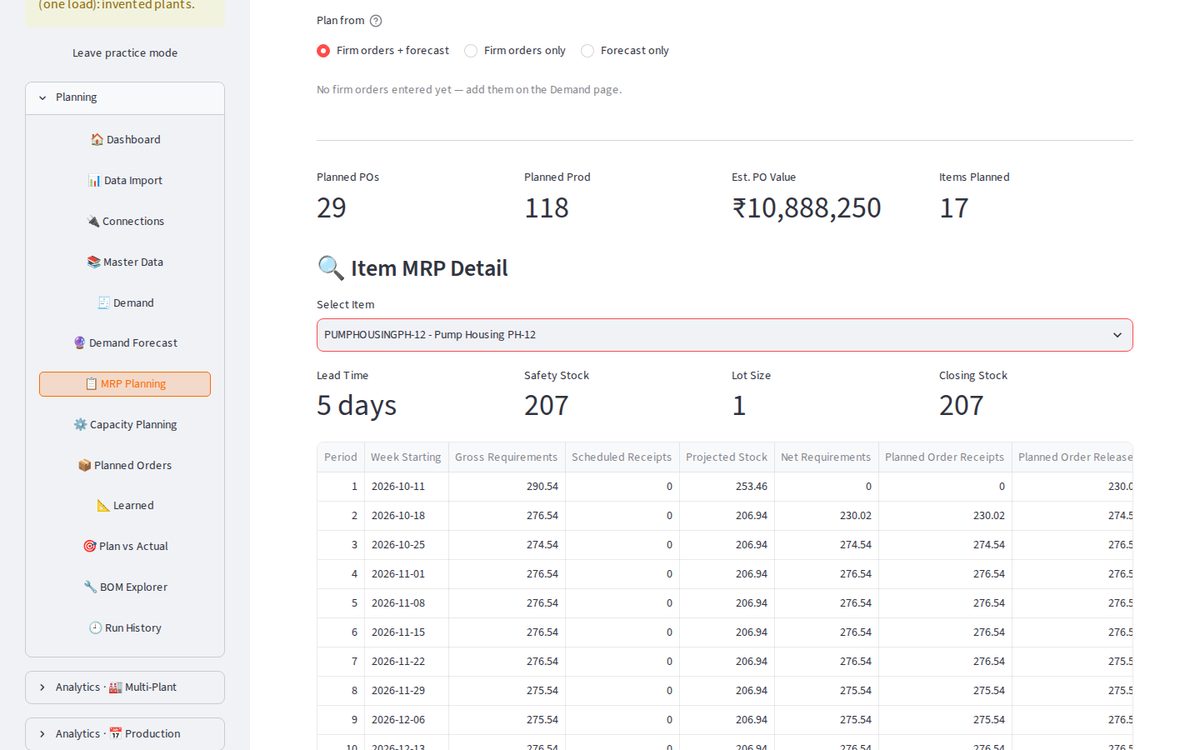
Stock, open orders, safety stock and lead times netted period by period. You see projected stock week by week — not one total that hides the week you run dry.

🏭

Capacity Planning

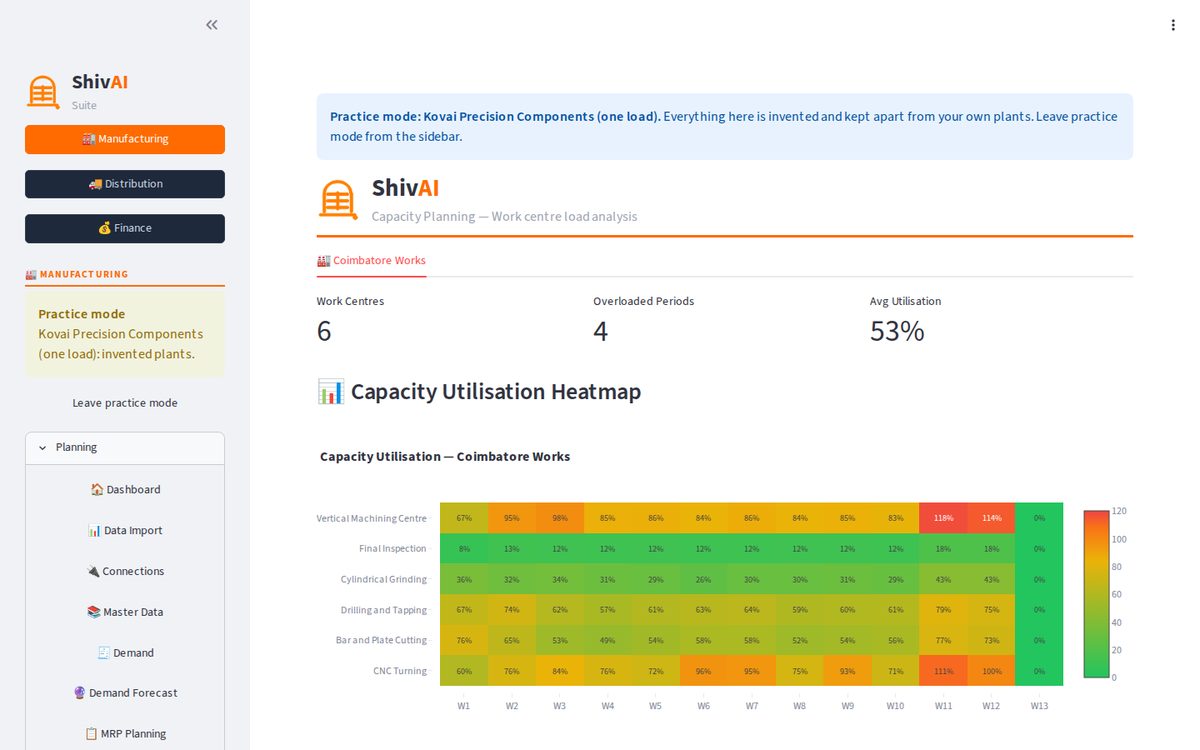
Routings and work centres, with load against available hours per period. The overloaded weeks are named before you commit to a delivery date.

🔌

Reads Your Own Systems

Tally, or any SQL database — SQL Server, MySQL, PostgreSQL, or anything with an ODBC driver. Excel still works for a plant that has nothing else.

📐

Measures What Actually Happens

Real supplier lead times, real yields, and safety stock sized from the error your forecast really makes. Measured from your own history, not assumed.

🎯

Scores Its Own Plan

Did last month's plan hold? Where it didn't, which of four causes cost the most — and which of them is a parameter problem rather than a follow-through problem.
It Reads Your System. You Stop Re-Keying.

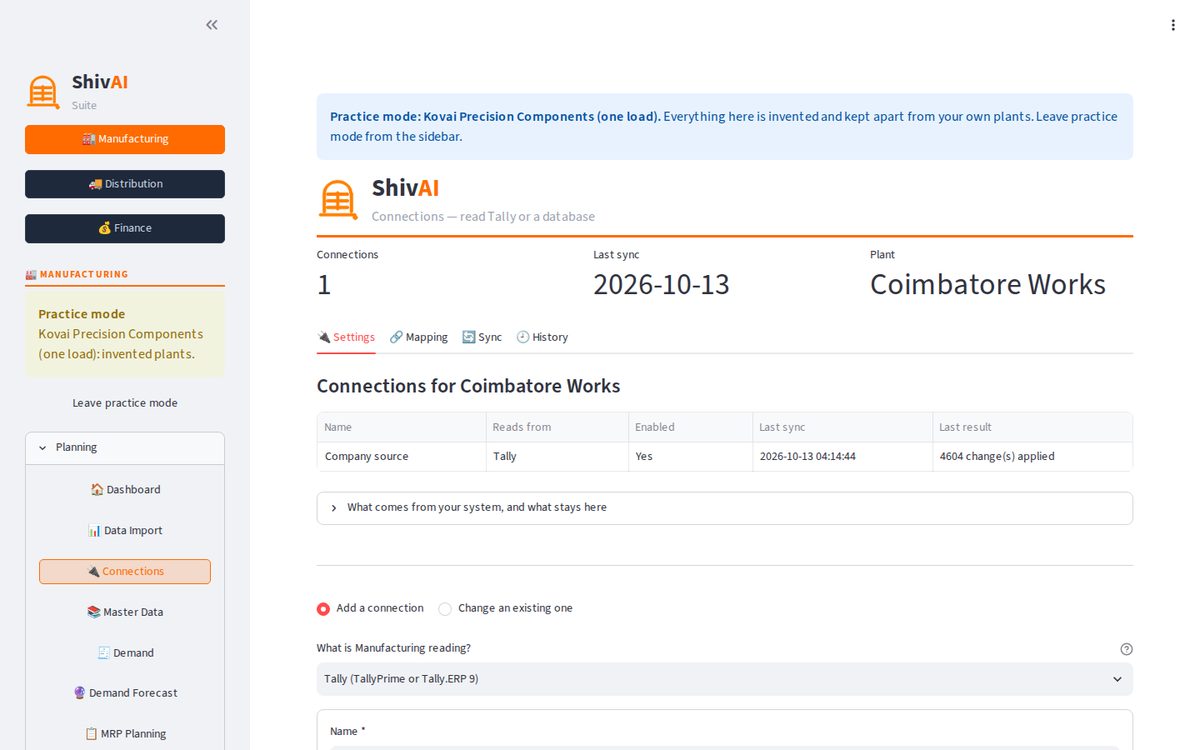
Stock items, suppliers, stock by store, purchase and sales orders, and goods received — brought across on demand, as often as you like.

📗

Tally

TallyPrime or Tally.ERP 9, over Tally's own XML interface. Nothing is installed in your Tally and nothing is ever written to it.

🗄️

Any SQL Database

SQL Server, MySQL, MariaDB, PostgreSQL — or Access, Marg, Busy and in-house systems through ODBC. Manufacturing Planner shows you your own tables; you write one query per thing it should read.

👁️

Nothing Is Written Until You've Seen It

Every sync produces a list first: every row it would add, every field it would change, the old value beside the new one. You read it and press Apply, or you don't.

✋

What You Typed Is Never Overwritten

A lead time you set by hand stays yours. If the source disagrees, the difference is shown — unticked. Accepting it is a deliberate act.

🔒

Manufacturing Planner Only Ever Reads

Every query is checked before it's sent, the connection is opened read-only, and nothing is committed. Give Manufacturing Planner a read-only database user and it needs nothing more.

🧪

Practice Mode

A sample Tally and a sample ERP database ship with ShivAI Suite. See a full sync end to end — before anything of yours is connected.

It Measures Your Business and Corrects Itself

Tally knows what you have. It doesn't hold a bill of material, a routing, a lead time or a safety stock — and it can't tell you whether the ones you're using are right. Manufacturing Planner measures them from your own records.

🚚

How Long Suppliers Really Take

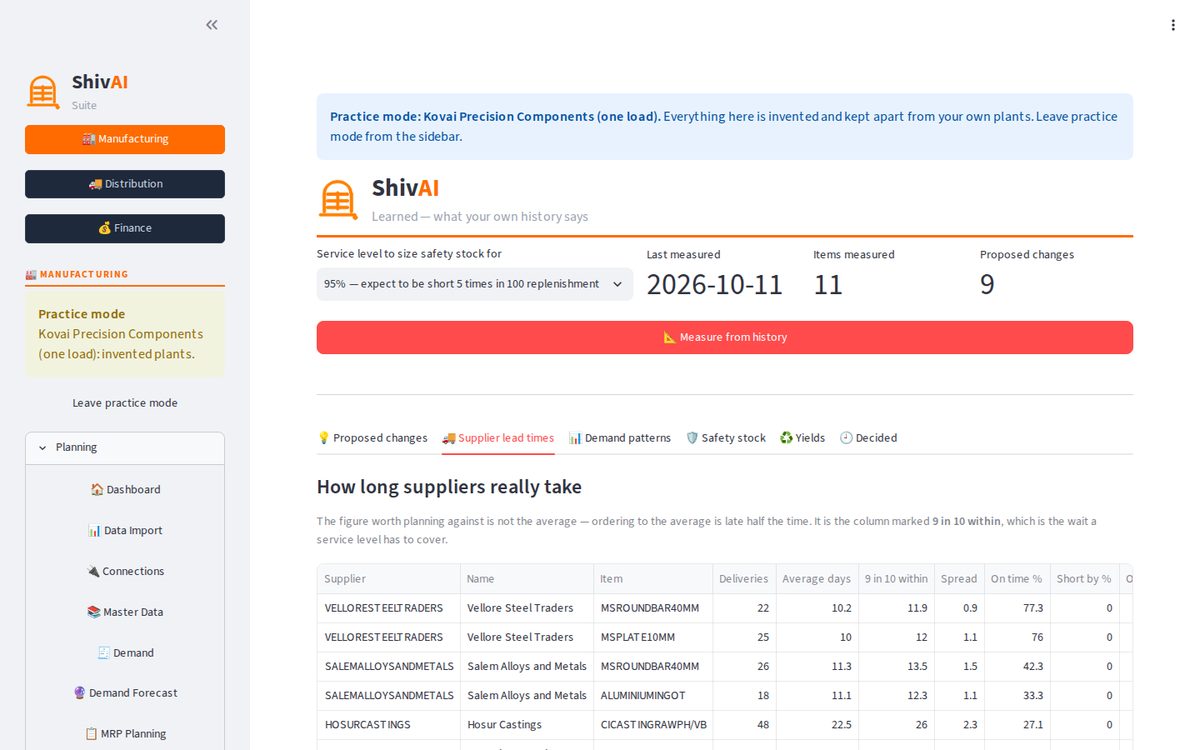
Measured from the day you ordered to the day it arrived. Not the average — ordering to the average is late half the time by definition. Manufacturing Planner suggests the figure nine deliveries in ten come in under.

♻️

What Comes Out Good

A part planned at 100% that really runs at 92% is short on every batch — the shortage nobody can explain. Once measured, MRP starts more than it needs to receive.

🛡️

Safety Stock That Fits the Part

Sized from the error your forecast actually makes and how much the lead time varies — not a round number of days that gives the same cover to a steady part and an erratic one.

📉

Slow Movers Forecast Properly

Croston, SBA and TSB for parts that sell four times a year. Ordinary smoothing fades to nothing between orders and then chases the spike after it has passed.

Every measurement is a suggestion, never a change. You see what you've set, what the history says, how many observations it rests on, and one line explaining why. You accept it or you don't — and accepting applies it to that plant only.

Did Last Month's Plan Actually Work?

For every part, the gap between the stock the plan predicted and the stock there actually was is split three ways — the plan started from a wrong opening figure, less arrived than it counted on, or more was used than expected. Those three add up exactly; anything left over is reported rather than hidden.

📦

The Order Was Never Raised

The most common single cause, and no parameter change fixes it. The plan was right, the orders were listed, nothing happened. Manufacturing Planner counts them and puts a rupee value on them.

⏰

The Supplier Was Late

Raised on time, arrived after the date promised. Measured in days, per supplier and per part — and fed straight back into the lead time Manufacturing Planner suggests.

📉

The Delivery Came Short

Arrived on time, but not all of it. Worth raising with the supplier, and worth knowing whether anybody chased the balance.

📈

Demand Was Higher Than Planned

The genuine forecasting problem — distinguished from the other three, because only this one is fixed by changing how you forecast.

Connect. Fill the Gaps. Plan. Review.

1

Connect

Point Manufacturing Planner at your Tally or your database. Items, suppliers, stock, orders and goods receipts come across — after you've read the preview.

2

Fill the Gaps

BOM, routings, work centres, lead times and lot sizes. The planning data no accounting system holds — entered once, then maintained.

3

Check the Data

Data Health lists what would quietly weaken a plan: made items with no components, parts with no lead time, routings pointing at an absent work centre.

4

Plan

Full MRP explosion, netting, capacity check and forecast in one run. Purchase and production suggestions with dates, suppliers and value.

5

Review and Correct

Measure your real lead times and yields. Score the plan against what happened. Accept what the history says, and plan again on better numbers.

Application Screenshots

MRP period table — requirements, projected stock and planned orders week by week
MRP — requirements and projected stock, week by week
Connections — what the plant reads, from where, and when it last read it
Connections — what the plant reads, from where, and when
Capacity planning — work centre load against available hours per period
Capacity planning — load against available hours
Learned — measured supplier lead times and yields, with the evidence behind each
Learned — measured lead times, with the evidence behind each

From the First Plan Onwards

Every
Shortage visible before it stops the line, not after
Zero
Re-keying — Manufacturing Planner reads the system you already run
Real
Lead times and yields, measured from your own history
Every
Plan scored against what actually happened

Built for Your Industry

Pumps, Motors & Castings

Assembled products with a real BOM, bought-out parts and foundry work.

Auto Components

Schedules from the OEM, tight delivery windows, penalties for being late.

Electrical & Electronics

Panels, wiring harnesses, long-lead imported components.

Fabrication & Machinery

Made-to-order with a standard sub-assembly library underneath.

Stop Finding Out You're Short After Production Starts

Single Location: ₹2,950/mo · Multi-Location: ₹5,900/mo (incl. GST). Annual billing gives 2 months free. 30-Day Paid Pilot — ₹5,900 incl. GST, includes full installation, training, and direct support. Part of ShivAI Suite: add Distributor Inventory Planner or Finance Planner in the same application — a bundle with Finance costs 20% less than its modules bought apart. 3 users included; an extra user is ₹590/mo.

Every plan includes every feature. The plans differ only in how many plants you load: one on Single Location, any number on Multi-Location. Runs on your own PC — your data never leaves it. If a subscription lapses Manufacturing Planner becomes read-only: every plan and every report stays available to view and export.

Related Products